
How do the ultra-long period radio pulsars differ from normal pulsars?
We ask the question: To what extent do ultra‑long period radio pulsars and transients (ULRa-TPs) differ from conventional radio pulsars? It is apparent that they rotate very slowly, but do they also behave differently in the emission physics, evolutionary pathways, magnetospheric structure and other observational characteristics.
Prof. Rai Yuen at the Xinjiang Astronomical Observatory investigates the emission properties in 10 ULRa-TPs against that of 100 FAST normal pulsars based on their emission geometry and several emission correlations well-known to radio pulsars. What matters here is that, if ULRa-TPs are different to pulsars, then any attempts to use pulsar emission models to explain ULRa-TPs would misinterpret the phenomenon.
By assuming that the ultra‑long period radio pulsars and transients as pulsars allows their fundamental emission geometry, such as the inclination angle, viewing angle, and emission height, to be estimated from their pulse widths and rotational properties using a standard pulsar-beam modelling.
The results show that the emission geometry is similar for the two populations, indicating that the observed differences between ULRa-TPs and the normal pulsars are not likely due to the emission geometry.
However, ULRa-TPs are different from the normal pulsars in the radiation spin-down, as shown in the figure, with ULRa-TPs displaying a significantly steeper change with decreasing height. In addition, a marginally difference in the relation of pulse-width with the geometric expansion of dipolar field lines was also found between the two populations. In general, ULRa-TPs emit at higher heights, but they display a negative correlation between dipole radiation and emission height. This implies that the efficiency or strength of magnetic dipole radiation decreases as the emission region moves higher from the stellar surface.
It may be that ULRa-TPs are not simply slow-rotating pulsars, but may possess a different emission arrangement, which likely due to the emission being generated from higher heights in the magnetospheres. Or, their observed properties may due to changes in the emission conditions that allow coherent radio bursts at such long periods.
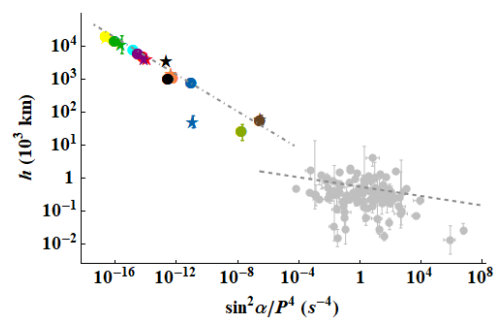
Figure: A log-log plot showing the changes in the emission height as a function of (sin2𝛼 /𝑃 4) for the ULRa-TPs and the normal pulsars. The lines of best fit are drawn in dashed and dot-dashed lines in gray for normal pulsars and ULRa-TPs, respectively. Here, the symbol 𝛼 represents the inclination angle between the magnetic and the rotation axes, h is the emission height, and P is the rotation period of a pulsar.
Attachment Download:





