
A Multitracer Analysis of the Sh2-252 A-B Star-Forming Region: Hub-Filament System
Recently, international PhD student Serikbek Sailanbek from the Star Formation and Evolution Group at the Xinjiang Astronomical Observatory, Chinese Academy of Sciences, conducted a study of the star forming region Sh2-252 A-B using ammonia data obtained with the Nanshan 26-m radio telescope and many other data such as CO from PMO 14m telescope. The results of this research were published in the international peer-reviewed journal Research in Astronomy and Astrophysics.
The researchers present a concise summary of the study on the S252A-B star-forming region, which reveals an active hub-filament system (HFS) driven by global hierarchical collapse rather than cloud-cloud collision. Using multi-tracer molecular line observations (CO isotopologues, NH₃) and far-infrared dust continuum data, they examined high-resolution morphological, kinematic, thermal and dynamical properties of S252A-B.
Six distinct filament branchesF-NE (northeast), F-NW (northwest), F-W (west), F-N (north), F-SW (southwest), and F-SE (southeast)converge onto the main S252A-B hub and secondary S252A hub in a spoke-like structure (see Figure 1), showing hierarchical density from diffuse CO envelope to dense NH₃ cores. The filaments are coherent in space and velocity, remain cold at around Tₖᵢₙ ≈ 15–18 K with a “shielded flow” that sustains accretion, and the virial parameter (αᵥᵢᵣ ~ 0.4–0.6) confirms that the central hub is gravitationally bound and collapsing.
Double-peaked spectra are detected only toward the south-western edge of the region with no associated young stellar objects, which rules out cloud-cloud collision as the main trigger of star formation in S252A-B.
This work provides definitive evidence for an active hub-filament system and shows that feedback-driven compression and gravitational focusing work together to channel mass toward active star-forming sites. It also emphasizes the critical importance of high-resolution kinematic observations for distinguishing between different star formation mechanisms, while delivering key insights into interstellar gas dynamics, turbulence, and the physical processes that drive stellar birth.
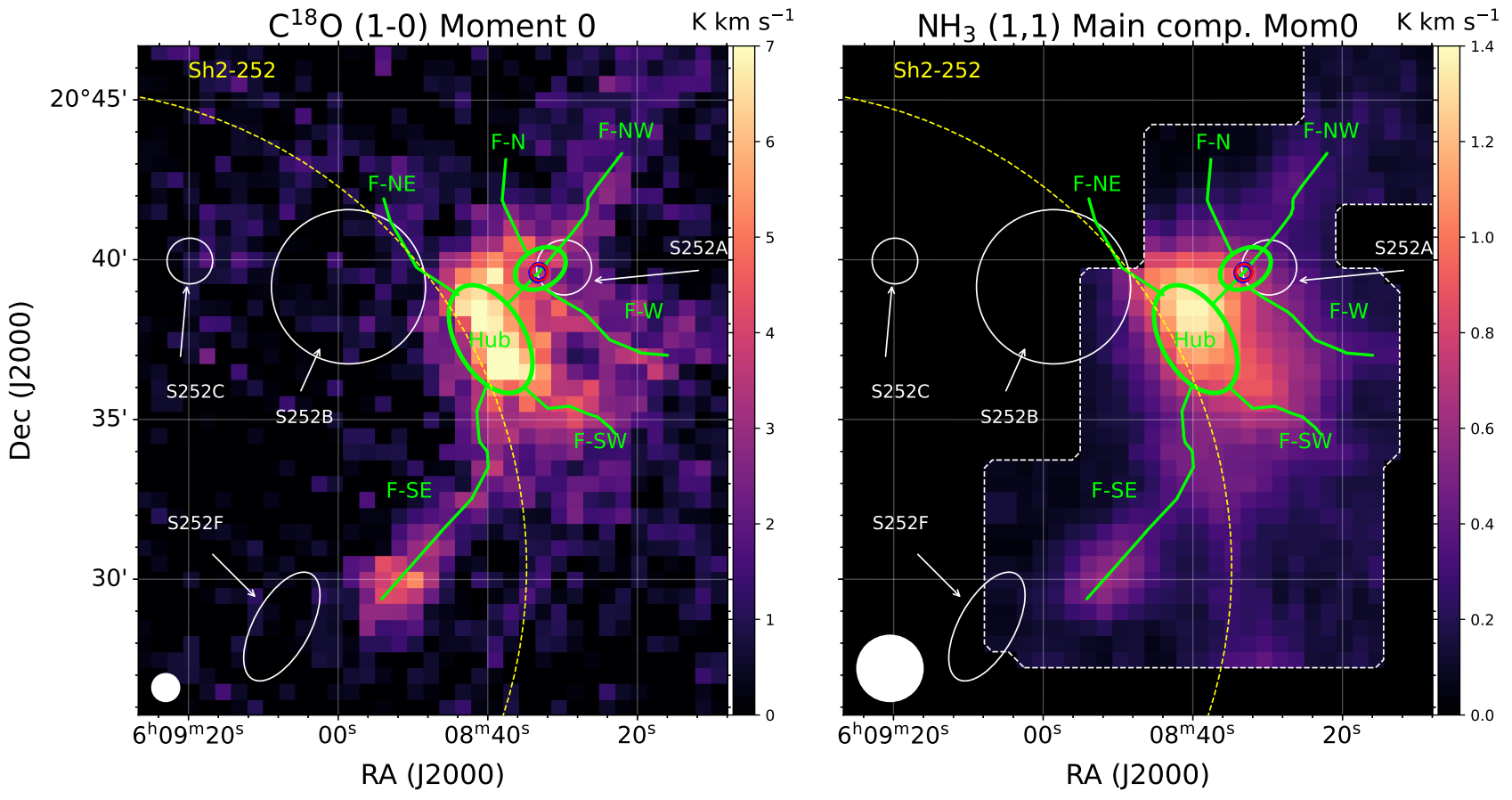
Figure 1. C18O (J = 1–0) (left) and NH3 (1,1) (right) integrated intensity (Moment 0) maps of the S252A-B star-forming region. Green solid curves trace the spines of the identified filamentary branches (labeled F-NE, F-N, F-NW, F-W, F-SW, and F-SE) converging upon the main “Hub” (marked by the large green ellipse). A secondary hub structure near S252A is indicated by the smaller green ellipse. White circles and ellipses label the positions of the H II regions S252A, S252B, S252C, and S252F. The yellow dashed curve traces the boundary of the ionization front from the main Sh2-252 H II region. The small red circle marks the position of water and methanol masers associated with the star-forming core inside the secondary hub structure. In the right panel, the white dashed polygon outlines the boundary of the NH3 mapping area. The filled white circle in the bottom-left corner of each panel represents the effective beam size
Attachment Download:




