
H2CO Reveals the Dynamical Characteristics of Early Star Formation in Planck Cold Cores
Recently, Yernar Imanaly, a doctoral student in the star formation and evolution group at the Xinjiang Astronomical Observatory of the Chinese Academy of Sciences, conducted an observational study of formaldehyde (H2CO) absorption lines at the 6 cm band toward 73 Planck cold cores using the Nanshan 26-meter radio telescope.
The study systematically analyzed the physical properties, turbulent states, and early gravitational evolution characteristics of dense gas within the cold cores. The results have been published in the international astronomical journal “Monthly Notices of the Royal Astronomical Society” (2026, 549, stag904).
Star formation begins in cold, dense cores. Therefore, observational studies of dense and cold cores are crucial for revealing the initial conditions and early processes of star formation, and constraining and developing star formation theories.
The large number of cold cores discovered by the Planck satellite provides an excellent sample for studying the earliest stages of star formation. Molecular spectral line observations can be used to investigate the internal gas excitation states and dynamical evolution processes. Among these lines, the H2CO absorption line at 6cm band is highly sensitive to cold dense gas, making it well suited for probing the internal structure and dynamical states of cold cores.
The researchers detected H2CO absorption lines in 51 of the 73 target sources, corresponding to a detection rate of 69.9%. Among these, 24 sources exhibited resolved hyperfine structure (HFS), accounting for 32.9% of the total sample. Analysis shows that non-thermal motions are generally stronger than thermal motions in cold cores where H2CO absorption lines were detected. Approximately 96% of the sources exhibit supersonic turbulence, indicating that turbulence plays a significant role in the early star-forming environment.
For the 24 sources with HFS structure, the researchers precisely calculated their H2CO excitation temperatures, which range from 2.08 to 2.59 K, with an average of approximately 2.37 K. HFS sources generally exhibit narrower line widths, lower Mach numbers, higher column densities, and greater optical depths, suggesting that these regions are dynamically relatively quiescent and may be evolving toward the early gravitational collapse phase.
The virial parameterαvir is a key indicator of the gravitational binding state of molecular cloud cores, with a critical value of about 2; values below this limit suggest that the system may be in a state of gravitational collapse. The figureshows the distribution of the virial parameter αvir in the Planck cold core subsample for which virial parameters could be estimated.
The results show that most cold cores have αvir > 2, indicating that they have not yet entered global gravitational collapsing stage. Only a subset of cold cores with detected HFS structure exhibit relatively low αvir values, approaching a gravitationally bound state. Among them, G168.13−16.39, G174.08−13.24, and G177.97−09.72 have αvir values below the critical value of 2, suggesting that they may have already entered the early gravitationally bound or collapsing stage.
Based on formaldehyde absorption line observations with the Nanshan 26-meter radio telescope, the researchers calculated and analyzed the excitation temperatures, turbulence, dynamical states, and virial parameters of Planck cold cores, finding that most of them are in a non-gravitationally bound state. These findings support the hypothesis that Planck cold cores are in the early stages of star formation.
The results provide new observational evidence for understanding the initial conditions of star formation, the role of turbulence, and the early gravitational collapse process.
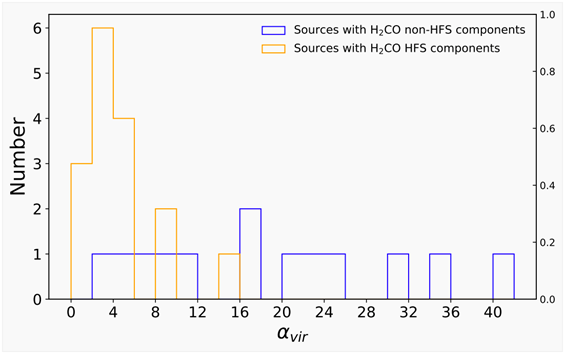
Distribution of the virial parameter αvir for a subset of Planck cold cores. Most sources have αvir values greater than 2, while a small number of sources with H2CO hyperfine-structure fall below the critical threshold of 2, suggesting that they may be closer to the early gravitationally bound or collapsing stage.
Attachment Download:




