
Researchers Discover Direct Observational Evidence for Chromospheric Magnetic Reconnection Driving Quasiperiodic Coronal Jets
Solar jets are common transient plasma ejection phenomena in the solar atmosphere, observable in multiple wavebands such as Hα, extreme ultraviolet (EUV), and X-ray. But coronal jets continuously transport mass and energy from the lower to the upper atmosphere and are considered a potential source of coronal heating and solar wind acceleration. The formation of coronal jets is primarily attributed to two driving mechanisms: magnetic reconnection and magnetoacoustic waves.
In recent years, high-resolution observations have revealed that coronal jets exhibit periodic eruptions. However, the driving mechanism behind these quasiperiodic coronal jets still lacks direct observational evidence.
Under the guidance ofProf. SHEN Jinhua, master's student GU Shuai from the Solar Physics Research Group at the Xinjiang Astronomical Observatory used high spatiotemporal resolution observations from space (SDO) and ground-based (NVST) telescopes to discover direct observational evidence for the quasiperiodic magnetic reconnection driving mechanism of coronal jets.
The results indicate that the quasiperiodic coronal jets are driven by quasiperiodic magnetic reconnection, while the reconnection process is modulated by slow magnetoacoustic waves in the chromosphere. These findings have been published in The Astrophysical Journal.
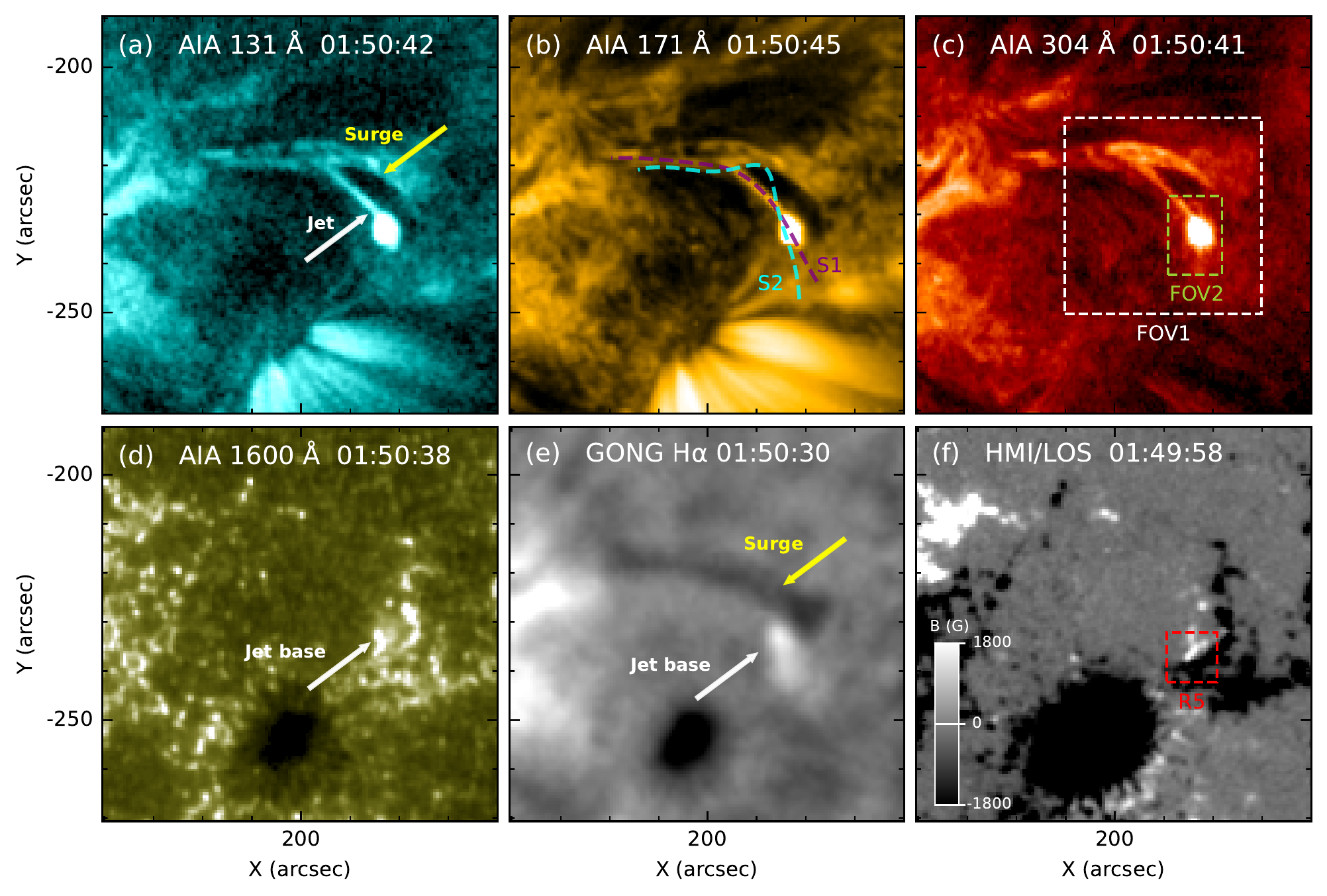
Figure 1: Panels (a)-(d): AIA images in the 131 Å, 171 Å, 304 Å, and 1600 Å passbands, showing an example of a coronal jet. Panels (e) and (f) are the Hα line-core image from GONG and the magnetogram from HMI, respectively. The dashed lines S1 and S2 in panel (b) indicate the positions of the slit used for the time–distance diagrams in Figure 3. White and yellow arrows mark the jet and the surge, respectively.
The observations of Active Region 13468 (2023 October 23, 01:00-04:00 UT) show dozens of hot coronal jets and cool surges. The local magnetic field evolution shows continuous magnetic flux emergence, convergence, and cancellation in the photosphere around the jet base. In addition, these events include continuously erupting plasmoids and two groups of quasiperiodic jets with periods of 2-3 minutes.
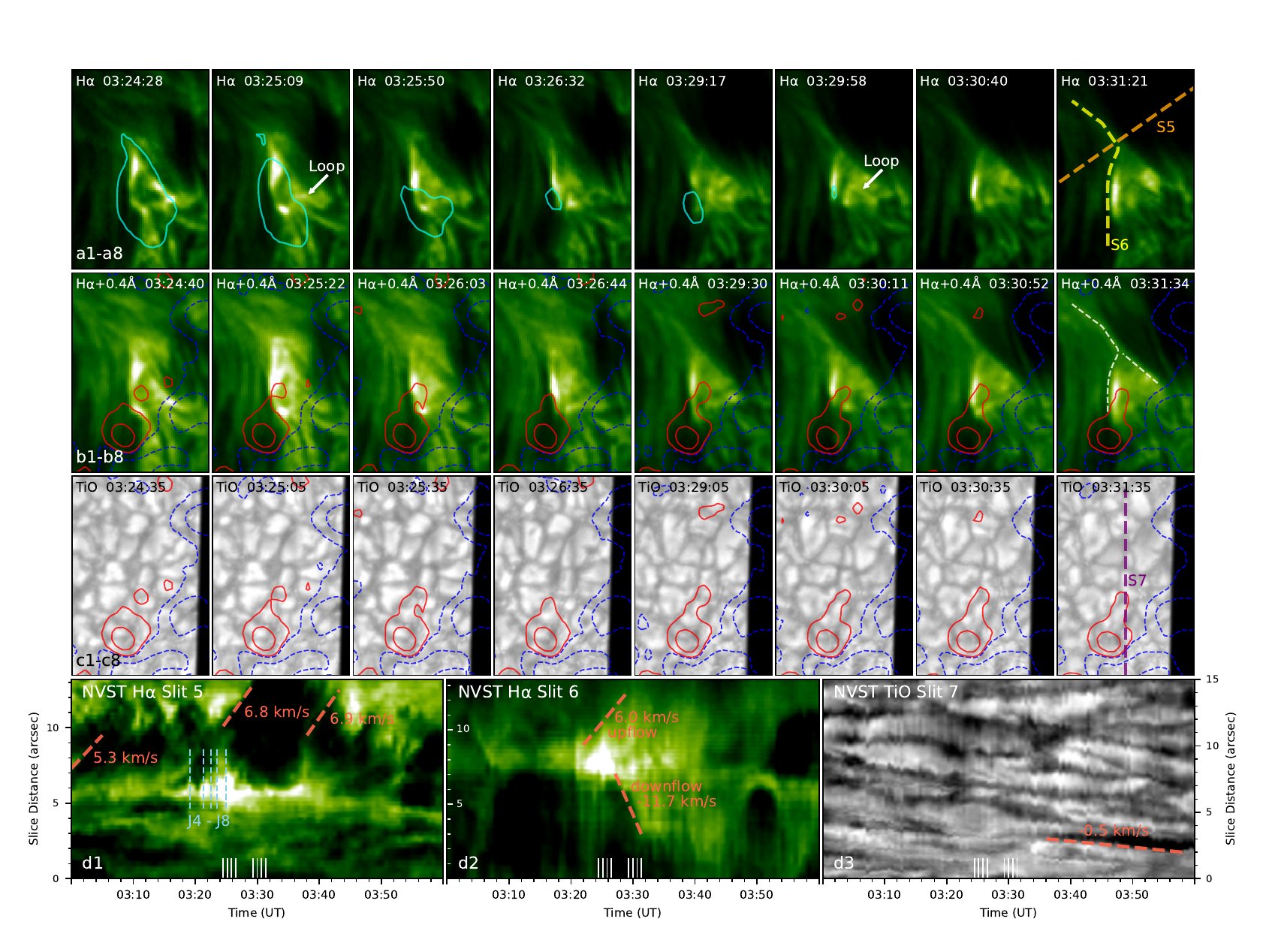
Figure 2: Panels show Hα line-core, Hα +0.4 Å, and TiO band images. Red and blue contours represent positive and negative photospheric magnetic fields, respectively. Panels (d1)-(d3) present time-distance diagrams obtained along slits S5-S7. The blue dashed lines correspond to the peak times of the quasiperiodic coronal jets (J4-J8) in Figure 3(i).
Based on high-resolution NVST observations (Figure 2), the researcherscaptured ongoing magnetic reconnection processes in the chromosphere. The jet base region exhibits a typical inverted-Y-shaped structure. Bright kernels near the reconnection current sheet move along this Y-shaped structure, and the current sheet displays quasiperiodic brightenings. Importantly, EUV and Hα observations show a clear spatiotemporal correspondence between the quasiperiodic brightenings in the chromospheric current sheet and the coronal jets, suggesting that quasiperiodic magnetic reconnection drives the quasiperiodic coronal jets.
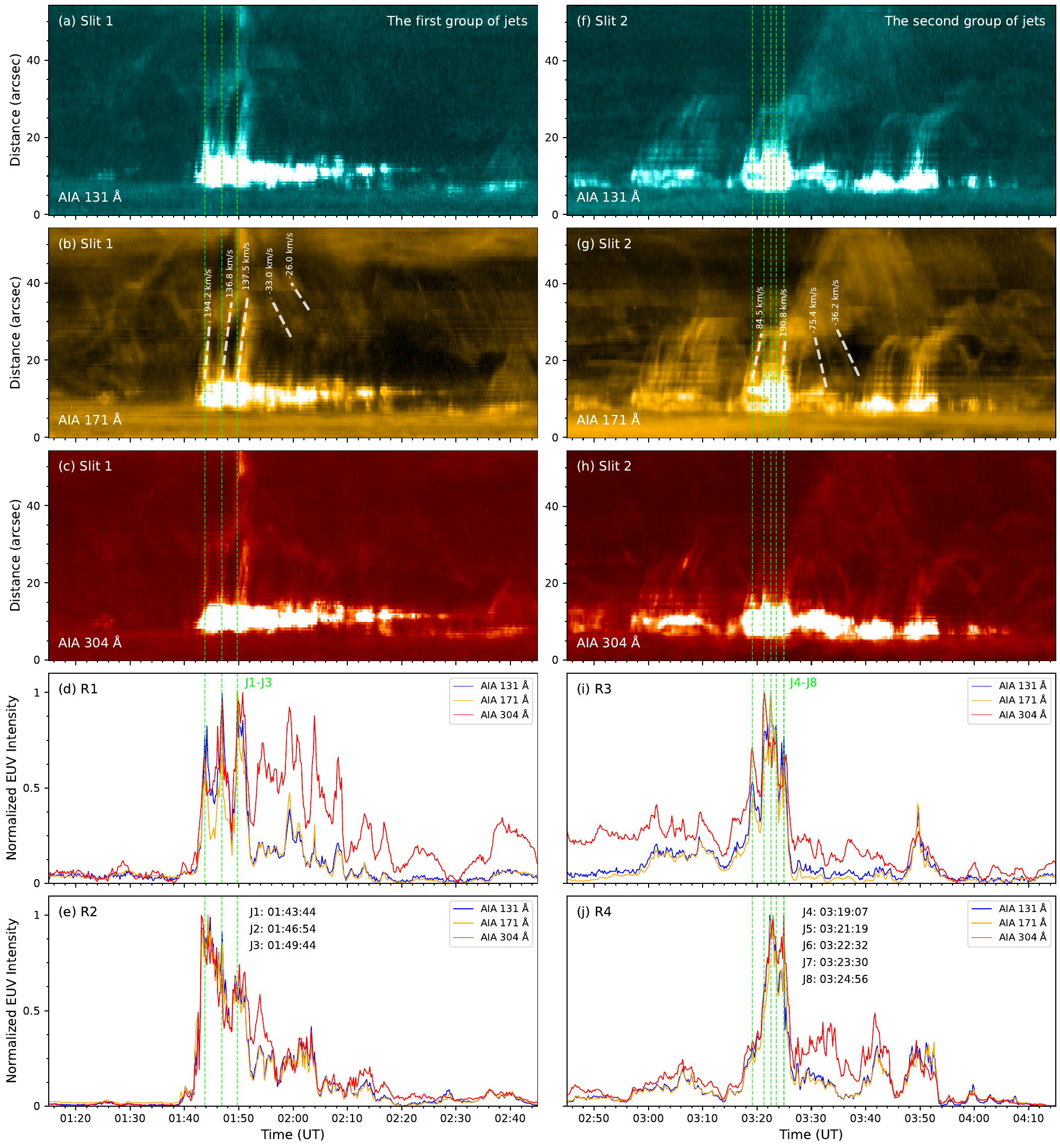
Figure 3: Panels (a-c) and (f-h) display repeatedly erupting jets observed in the AIA 131 Å, 171 Å, and 304 Å passbands. Panels (d-e) and (i-j) show the EUV light curves (at 131 Å, 171 Å, and 304 Å) for the two jet groups in different regions.
Analysis shows that the jetshave a quasiperiodicity of approximately 2-3 minutes, with significant EUV intensity enhancements and multi-peak impulsive features, indicating intermittent energy release. Meanwhile, the jet footpoints (observed in 1600 Å) show repetitive brightenings and outflows, suggesting that a flare-like magnetic reconnection process likely occurs in the lower atmosphere. The research team concludes that these quasiperiodic coronal jets originate from quasiperiodic magnetic reconnection in the chromosphere.
This study provides the first direct observational evidence of a spatiotemporal correspondence between quasiperiodic coronal jets and quasiperiodic magnetic reconnection in the chromosphere. The coronal jets in this study lasted for 40-60 minutes and maintained a 2-3 minute quasiperiodicity. A magnetic reconnection process alone cannot easily explain both the duration and the quasiperiodicity, implying the presence of an external modulation mechanism.
The observed period is similar to that of slow magnetoacoustic waves in the chromospheric resonant cavity, suggesting that such waves may modulate the reconnection process. Although wave-modulated reconnection is a small-scale process difficult to resolve directly with current observational facilities, this research concludes that the quasiperiodic coronal jets are driven by quasiperiodic magnetic reconnection, which in turn is modulated by slow magnetoacoustic waves in the chromosphere.
This work was supported by the Strategic Priority Research Program of the Chinese Academy of Sciences, the National Natural Science Foundation of China, the Natural Science Foundation of Xinjiang Uygur Autonomous Region, and other programs.
Attachment Download:





